

Balrampur Chini launches Bioyug Green Command 2026 to drive India’s bioplastics revolution
Balrampur Chini Mills launches Bioyug Green Command 2026 on World Environment Day to accelerate India's bioplastics revolution with PLA-based sustainable solutions.
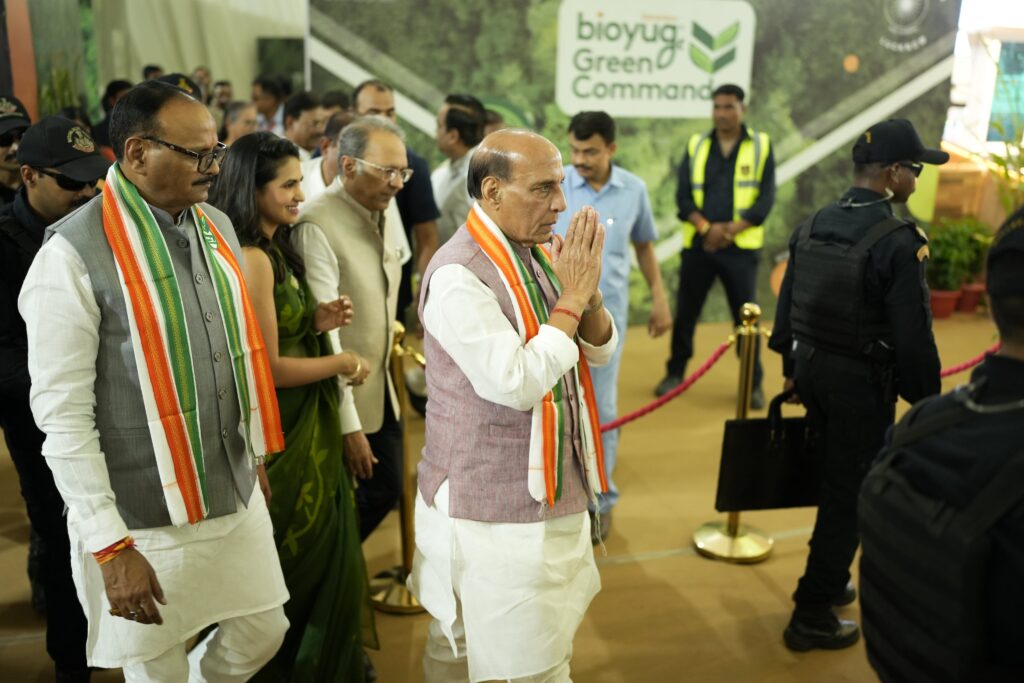
Balrampur Chini Mills Limited (BCML) formally launched Bioyug Green Command 2026 on Friday, marking World Environment Day with a first-of-its-kind platform aimed at accelerating India’s bioplastics revolution and reducing the nation’s dependence on conventional petroleum-based plastics.
The launch, held in collaboration with the Lucknow Cantonment Board, was presided over by Union Defence Minister Rajnath Singh as chief guest, signalling growing government support for bio-based indigenous manufacturing as a strategic national priority.
The event formalised a landmark collaboration between Balrampur Bioyug and the Lucknow Cantonment Board following an earlier memorandum of understanding and BCML’s first institutional order for compostable polylactic acid (PLA)-based products. PLA, derived from sugarcane, is a fully organic bioplastic that breaks down within 180 days and converts into compost rather than waste.
Speaking at the launch, BCML Chairman and Managing Director Vivek Saraogi said India stood at a defining moment where economic growth and environmental responsibility must advance together.
“Through Bioyug Green Command 2026, we are bringing together government, industry, institutions and communities to accelerate this transition and demonstrate how innovation-led solutions can contribute meaningfully to a cleaner, greener and more self-reliant India,” Saraogi said.
Executive Director Avantika Saraogi framed the shift to biomaterials as an economic opportunity as much as an environmental necessity.
“The last century belonged to oil and petrochemicals; the next can belong to farmers and fields,” she said. “The materials of the future will not only be mined from beneath the earth but cultivated above it, through the power of agriculture.”
Addressing the gathering, Defence Minister Singh drew attention to the accelerating public health toll of microplastics, citing scientific research indicating that approximately 350,000 people die globally each year due to microplastic exposure, with plastic particles now detectable in the blood of newborns.
Singh highlighted the national security dimension of the transition to bioplastics, noting that India’s existing 20% ethanol blending programme had shielded the domestic economy from supply chain disruptions triggered by recent West Asian geopolitical turbulence.
“By generating resources from our sugarcane, rice, and organic waste, we will strengthen our security framework,” Singh said. “While fulfilling our environmental obligations, we can become a self-reliant, bio-based economy.”
Two high-level panel discussions formed a centrepiece of the programme. The first, titled “Mandate to Market: Unlocking the Bioplastics Value Chain in Uttar Pradesh,” examined policy support and market opportunities required to scale bioplastics adoption. The second, “From Mess to Mission: Bioplastics for Defence,” explored sustainable material integration within defence establishments.
A parallel highlight was the felicitation of meritorious ITI girl students from Lakhimpur Kheri, Uttar Pradesh, participating in the “Building Skills. Transforming Futures” initiative — a women-focused 3D printing training programme using Bioyug PLA, run by Balrampur Foundation in partnership with ITI Mohammadi.
BCML, one of India’s largest integrated sugar companies, is currently developing the country’s first PLA plant with a capacity of 80,000 tonnes per annum. The company operates ten sugar factories across Uttar Pradesh with an aggregate crushing capacity of 80,000 TCD.
The event drew participation from over 2,000 stakeholders spanning government, industry, academia, defence, and civil society.
Bioyug Green Command 2026 is anchored in the proposition that “the future of materials is grown, not drilled,” positioning India’s agricultural base as the foundation of its emerging circular bioeconomy.
More Stories



Related News
© 2026 CSR Voice. All Rights Reserved.
Powdered by © Snowchild Studio