

From pilots to policy: what DEVI Sansthan’s Ladakh MoU tells us about social finance
DEVI Sansthan’s move from an SSE fundraising issue to a three-year Ladakh MoU shows how social finance can help turn education pilots into public policy.
S Eldee
The real test of India’s social sector is not how many pilot projects we can launch, but how many of them survive long enough to become policy. For years, the story has been familiar: a promising NGO runs a small, donor‑funded experiment in a few districts; evaluations look good; then the money runs out, the team shrinks, and the model remains a footnote in a PowerPoint.
The recent trajectory of Lucknow‑based DEVI Sansthan — from a modest Zero Coupon Zero Principal (ZCZP) issue on the BSE Social Stock Exchange to a three‑year Memorandum of Understanding with the Ladakh administration — hints at a different path: one where social finance, if designed well, can help turn pilots into public programmes.
DEVI’s journey began, in market terms, as a niche experiment. In June–July 2026, the organisation listed on the BSE Social Stock Exchange, raising about Rs 1.10 crore through ZCZP instruments priced at Rs 1 each, with a minimum ticket of just Rs 1,000. The pitch was simple: investors would not get interest or principal back; instead, their money would fund foundational literacy and numeracy (FLN) programmes for tens of thousands of children in government schools, with impact tracked and reported under SEBI’s social exchange framework.
For a sector used to CSR cheques and foundation grants, this was novel: a regulated, transparent, retail‑accessible channel for “human returns” rather than financial ones.
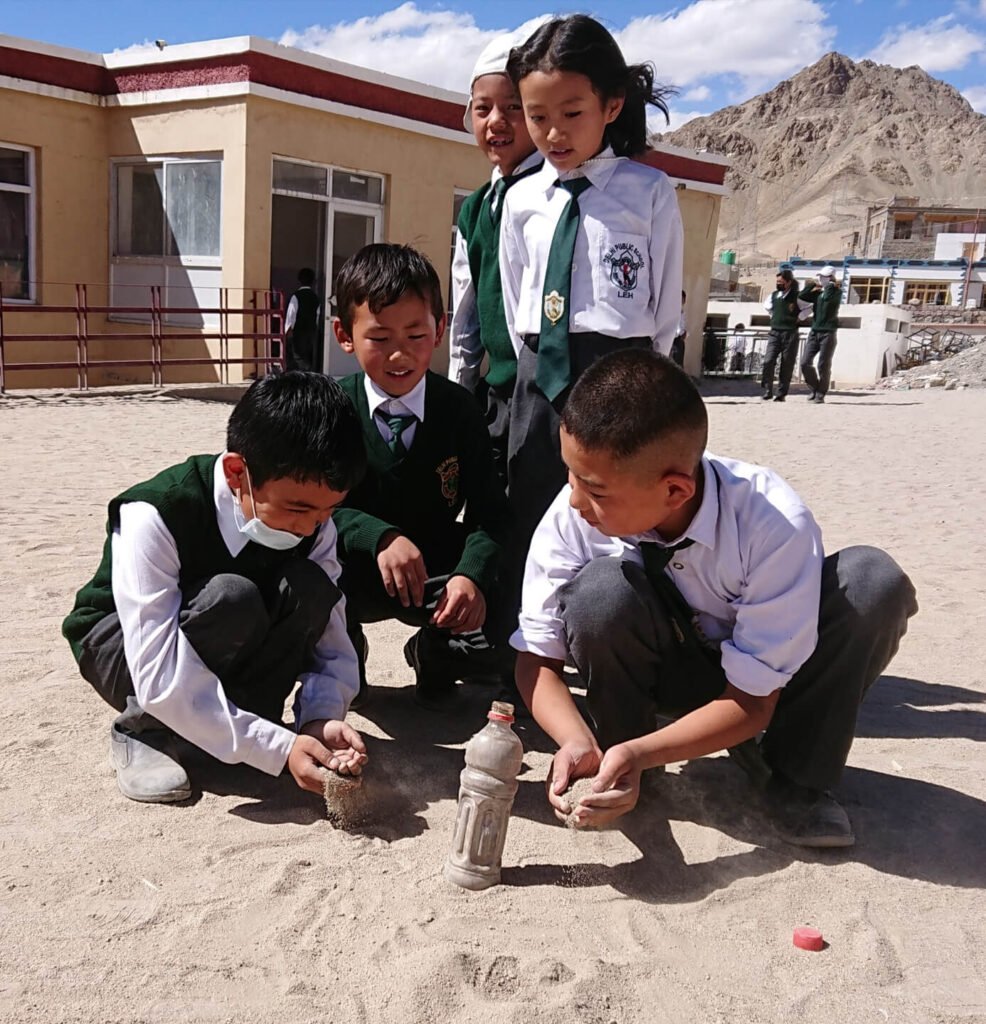
What makes the Ladakh MoU, signed on 11 August 2026, significant is not just that a union territory chose an NGO partner, but that it chose one that had already tested its model in the market. Under the three‑year agreement, DEVI Sansthan will work with Ladakh’s School Education Department to strengthen FLN across the region, aligning with the national NIPUN Bharat mission’s goal that every child attain grade‑level reading and arithmetic by Class 3. In effect, capital raised through the Social Stock Exchange is being leveraged into a multi‑year, government‑backed scale‑up — exactly the transition that India’s education and social sectors desperately need.
This sequence — SSE issue first, government MoU later — matters for three reasons.
First, it shows that social stock exchanges can do more than raise money; they can de‑risk scale. When a government signs a multi‑year contract with an organisation that has already disclosed its finances, governance and impact metrics on a regulated platform, it reduces the information asymmetry that often stalls public procurement of social services. The SSE listing acts as a form of due diligence that is visible to citizens, donors and officials alike.
Second, it begins to solve the pilot paradox. India does not lack successful education pilots; it lacks mechanisms to move them from “project mode” to “system mode”. By allowing NPOs to raise patient, no‑repayment capital for specific outcomes, and then letting governments layer on longer‑term contracts, the SSE framework can help convert proof‑of‑concept into proof‑of‑scale. DEVI’s Ladakh deal is still early, but it is a template: market‑tested model, transparent reporting, then public adoption.
Third, it offers a new narrative for CSR and philanthropy. Instead of one‑off grants that vanish after a news cycle, corporate and individual investors can back organisations that are building towards government partnerships. The “exit” is not an IPO or acquisition, but a policy uptake — the moment when the state says: this works, we will fund it at scale. That is a far more durable form of impact than any annual report claim.
Of course, caution is necessary. A single MoU does not prove a trend; Ladakh’s unique administrative structure may not replicate easily in larger, more complex states. There are also risks: over‑financialisation of the social sector, excessive focus on easily measurable metrics at the cost of deeper learning, and the possibility that only a few well‑advised NGOs can navigate SEBI’s framework while smaller, grassroots groups are left behind. The Social Stock Exchange must remain a tool for mission, not a badge for marketing.
Yet, the direction is clear. If India is serious about fixing foundational learning, health, nutrition and livelihoods, it cannot rely on perpetual pilots funded by restless donors. It needs mechanisms that allow successful models to graduate into public systems with clarity on cost, quality and accountability. DEVI Sansthan’s path — from a Rs 1.10 crore ZCZP issue to a three‑year government partnership in Ladakh — is a small but telling sign that this graduation is possible.
The question now is whether other states, departments and donors are watching closely enough to replicate it.
More Stories


Related News
© 2026 CSR Voice. All Rights Reserved.
Powdered by © Snowchild Studio